
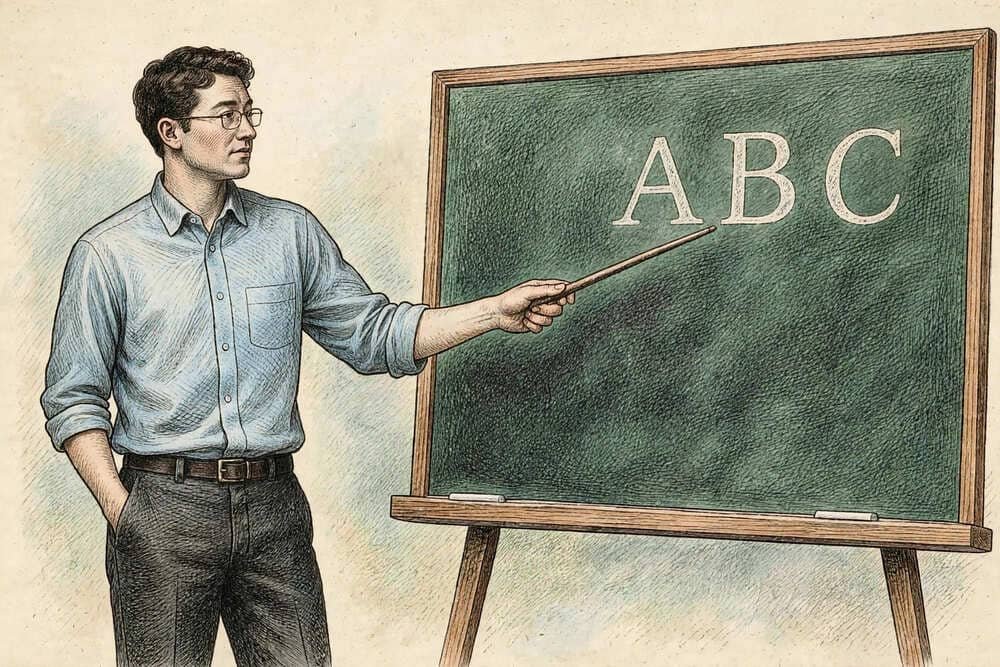
The reason is obvious to everyone.
I’m writing this post because I want to reinforce it to you and thus prevent you from feeling like you’re falling behind for focusing on “boring” fundamentals. For you may look at other learners and see how much further along they seem to be in their language-learning journey and question whether what you’ve been doing is worthwhile. But we’re not wrong for starting with the basics and taking the time to build a strong foundation.
A strong foundation will support you as you move on to more advanced material, making the learning process much easier and smoother along the way.
And just as the reason for starting with the basics is obvious and expected, so is the analogy I’m about to use to illustrate it.

Two people set out to build a house.
One is anxious to see the house, to dwell in it, to invite friends over and enjoy its rooms. So he gets started right away. Walls go up quickly. A roof is placed on top. Within weeks, he has something that looks like a home. And there it is: a beautiful, spacious house with large windows and a stylish design. It is tastefully decorated and catches everyone’s eye. Passersby stop to admire it and exclaim, “Wow!”
But it was built in a haste, ignoring important things that should be done before erecting the house.
Underneath, its walls were erected directly upon a loose, unstable base…
The other builder also dreams of the house.
He, too, longs to see it standing and to live within its walls.
But he understands, and doesn’t ignore, the fact that a house needs to have a strong foundation.
Without a strong foundation, problems that seem minor at first can gradually compound into serious structural, health, and financial disasters. The time and money you’ll eventually have to spend fixing the problems caused by impatience and unwillingness to wait can leave you discouraged and even make you abandon the construction altogether. Worse still, the house could collapse at any moment, destroying everything inside.
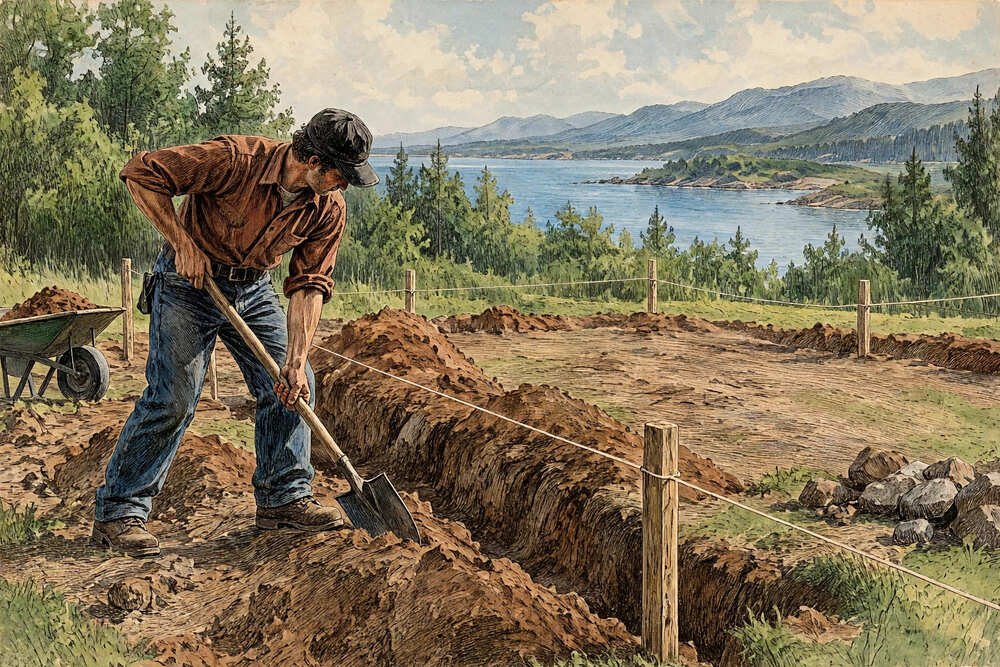
So, before raising a single wall, the builder digs.
He pours concrete.
He reinforce the base.
He spends weeks, perhaps months, digging deep, pouring concrete, and carefully building a strong, reinforced foundation. It is slow, tedious, and seemingly unrewarding work. Days go by, and there’s nothing to show but a slab of gray concrete. The sun rises and sets, yet there’s still no beautiful house to admire. Passersby begin to wonder why nothing is being built.
But he doesn’t care.
He knows he’s doing the right thing, so he keeps pushing forward.
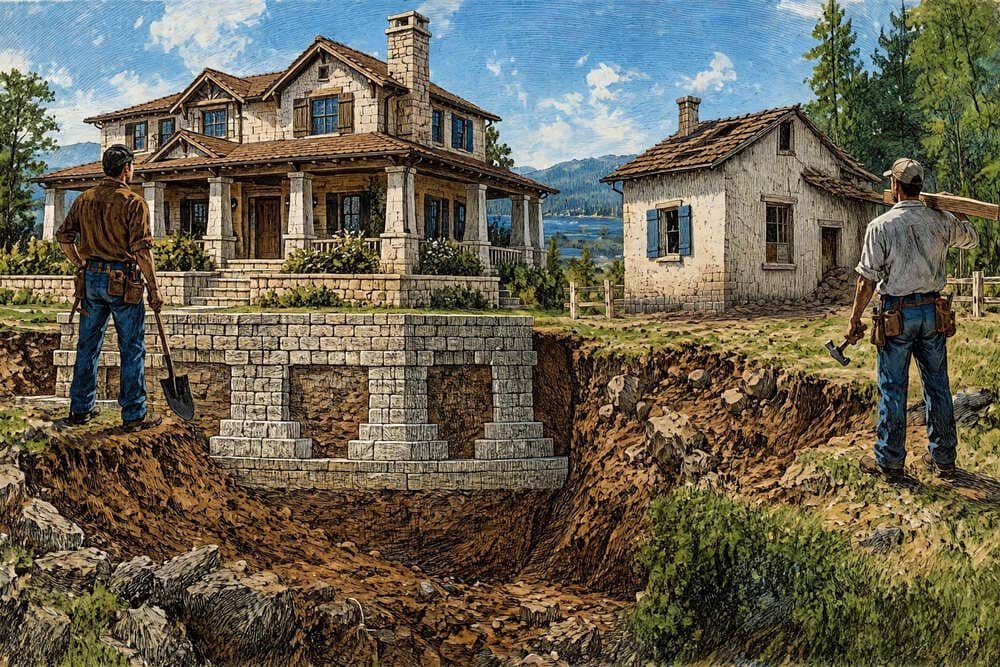
Failing to build a solid foundation creates countless problems down the road for those unwilling to take the time to lay one.
- Fixing a poor foundation can be costly, requiring expensive and ongoing repairs.
- Buyers avoid homes with foundation issues, which reduces the property value.
- Without a proper foundation, the house may settle unevenly, causing cracks to form in the walls.
- The entire structure may eventually collapse.
And the foundation is the one part of a house you can’t easily fix later on.
You’ll literally have to lift the entire house! You may even struggle to find someone qualified to do the job. And if you do find someone, can you imagine how expensive it would be? Think about it: you’re literally lifting an entire building off the ground and suspending it in mid-air while you build a foundation underneath. The cost can be astronomical, and also unpredictable: if something goes wrong during the lifting process, you may end up having to rebuild the entire house.
- And you would need to pay temporary housing while the house is uninhabitable: add thousands more.
- Permits and engineering fees: another thousands.
- Structural repairs discovered mid-lift: more thousands!
It would have been much better if the owner had been patient, followed the proper steps, and moved on to the next one only after completing the previous one.
He would have saved himself a lot of money and stress.
The second builder understands that his invisible, less glamorous work is precisely what will allow his house to withstand storms, support a second story, and stand firm for generations to come. With such a solid foundation in place, he can build a magnificent house on top of it. The walls remain free of cracks, and the entire structure is strong, stable, and safe.
The second builder never has to worry about lifting his house off the ground or demolishing it to start all over again.

This post, of course, is not about construction.
Spending time on the fundamentals of the language you’re learning is fundamental. One reason for this is a phenomenon in language learning known as fossilization, which is a process by which incorrect language patterns become ingrained in a learner’s speech or writing, making them increasingly resistant to correction. In other words, you learn something incorrectly from the very beginning and keep repeating the same mistake over and over, sometimes for years. Eventually, that incorrect pattern becomes so deeply ingrained in your mind that correcting it becomes much more difficult.
Again, a weak foundation is something you can’t easily fix later.
One example is learning to pronounce words incorrectly or produce certain sounds the wrong way.
Spending time on the basics will not only help you avoid internalizing incorrect patterns but also make everything that comes afterward go much more smoothly.
- The moment a student learn didn’t, he will be able to pronounce it easily and correctly.
- Noticing the difference between can and can’t in spoken American English will become much easier and faster.
- Learning phonograms will make you write faster (since you won’t have to wonder about the spelling or look it up) and correctly (since you’ll already know how different sounds are represented in writing).
These are just some examples.

People will tell you, ‘Start speaking from day one!’
But I personally prefer to teach/learn the first things first. Without a basic understanding of the sounds of the language and how to articulate them correctly, students are likely to develop incorrect pronunciation habits that go uncorrected. Later on, they’ll have to go back and relearn words and phrases they’ve already been using incorrectly. In some classes, students are paired up and asked to practice speaking with each other, meaning they may end up learning incorrect pronunciations from one another.
I think those who say we should start speaking from day one also say that we should learn like babies.
I don’t subscribe to the idea that we should learn languages the way babies do. But learning the sounds of a language first and practicing how to articulate them correctly in words—which is what I do on day one and consider part of the fundamentals—is actually much closer to how babies naturally learn than jumping straight into conversations from day one.
When students are plunged straight into vocabulary acquisition and conversation, they pronounce words using the sound patterns of their first language, mixed with a caricature of the target language.
The student becomes like the builder of that first house.
He has a collection of bricks, but no foundation and stable structure to build with.