
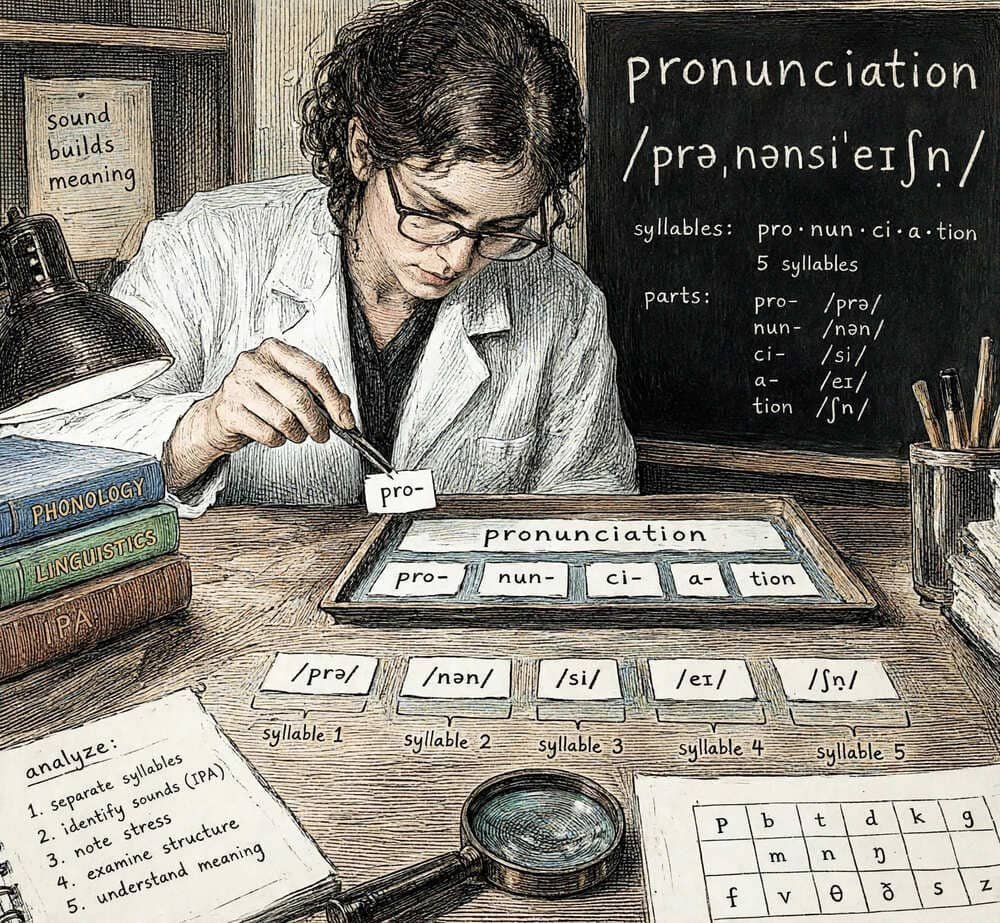
What is the IPA?
IPA stands for International Phonetic Alphabet.
It’s an alphabet, meaning it’s a set of written symbols used to represent words. It’s phonetic: each symbol maps to one specific speech sound, so it can accurately represent how words are actually pronounced. It’s international, meaning it’s designed to work for all languages, not just one: the same symbols are used by linguists and learners worldwide to transcribe sounds across all languages.
The International Phonetic Alphabet was created in France in the 19th century by a group of French and English language teachers.
Its main purpose was to help teachers and learners pronounce foreign languages accurately. The IPA has also been used by singers, actors, voice actors, linguists, lexicographers, and many others. By learning to read IPA transcriptions, you will become able to pronounce words from any language accurately just by reading (yes, just by reading!).
This happens because the IPA establishes a one-to-one relationship between symbols and sounds, representing one sound by a single, unique symbol.
As you know, in other alphabets, one letter can represent more than one sound depending on the language (or even within the same language). We can take English and Portuguese as an example. Both languages use the same writing system (the Latin alphabet), yet the same shared Latin letters can represent different sounds in English and Portuguese.
For example, in Portuguese, the Latin letter a is pronounced /a/ (like the vowel sound in the first part of the English word eye). In English, however, the letter a can represent several different sounds, such as /æ/ in cat, /eɪ/ in table, /ə/ in about, /ɛ/ in any, and /ɑ/ in water. Thus, the letter a has a different sound in Portuguese than in English (and in English it can be pronounced in several different ways).
The IPA solves this problem by assigning a unique symbol to each sound, regardless of the language.
For example, the IPA letter /ə/ always represents the same sound, whether it appears in the Russian word небо (sky) or the English word balloon:
Небо → /ˈnʲebə/
Balloon → /bəˈlun/
So, regardless of the language or word, each IPA symbol represents one specific sound. This consistency makes IPA transcriptions incredibly precise in conveying pronunciation information. It also helps language learners identify sounds in words that they might otherwise struggle to distinguish or perceive through listening alone. For these reasons, I think the IPA is an extremely valuable tool for language learners.

The IPA covers all linguistically relevant sounds used across languages, assigning a unique symbol to each one.
/ǂ/ represents one of those famous clicks of some African languages:
/ǃ/ is another African click:
/ʘ/ is another African click but made with the lips (it sounds like a kiss):
/ɨ/ found both in Tupi and Russian, this sounds like someone got punched in the stomach mid-word:
/ʙ/ is found in some Papuan languages.
/ɧ/ is found in the Swedish language.
The other type of “IPA”—which I call Improvised Phonetic Alphabet—is not international.
Because it is not an international system, it may be difficult for non-native speakers and beginners to understand. Transcriptions such as “pro-nun-see-AY-shun” assume that readers are already familiar with English spelling conventions and pronunciation patterns. While these approximations may be somewhat helpful for English speakers learning to pronounce unfamiliar words, they are less useful for beginner non-native learners, who are still developing their understanding of English sounds and spelling patterns.
Using the familiar letters and sounds of the learner’s native language to transcribe English pronunciation would not be helpful either, as these may not correspond closely to the sounds of English.
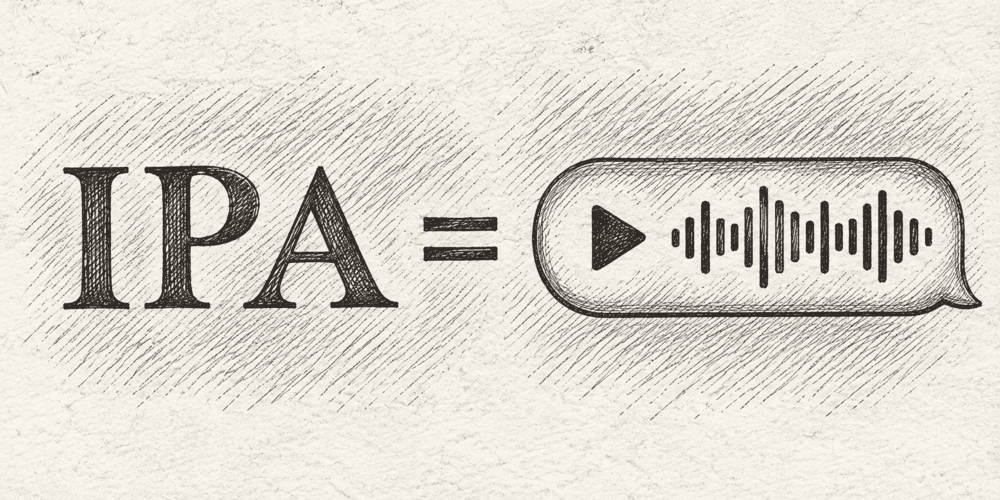
The International Phonetic Alphabet is the solution!
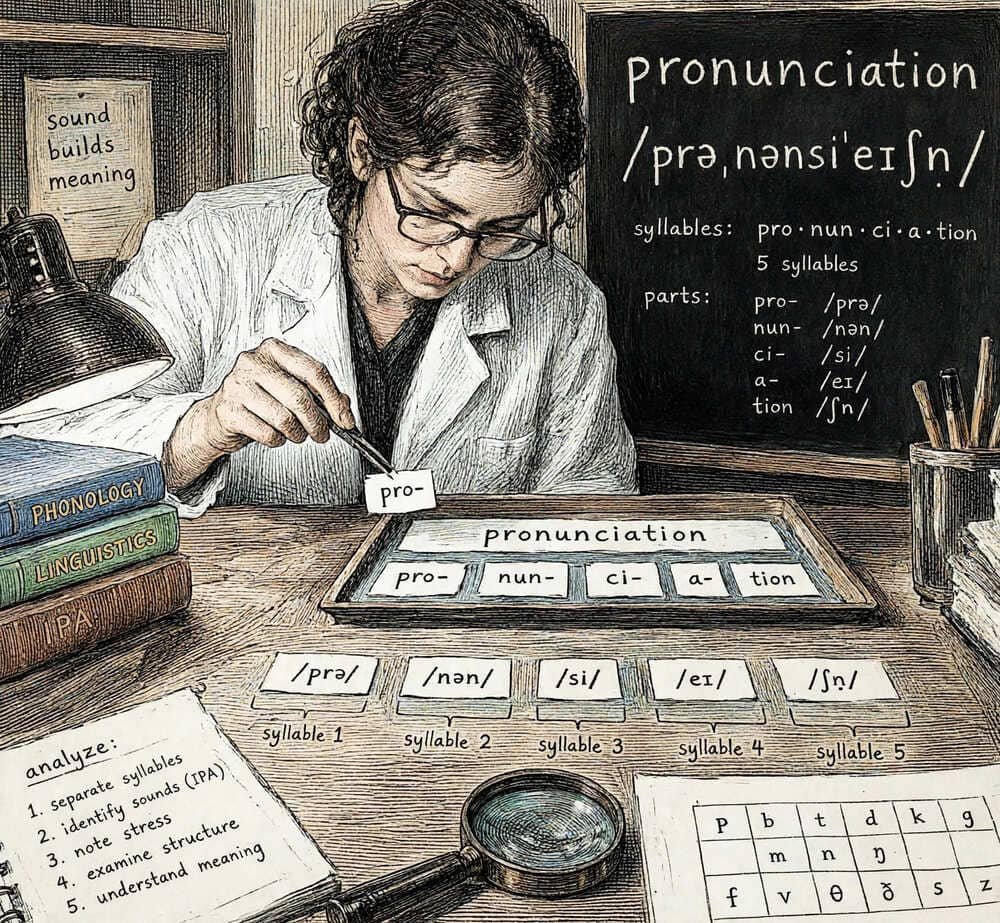
When you read an IPA transcription, you can see exactly how a word is pronounced. It’s incredible: /prəˌnənsiˈeɪʃn̩/ represents exactly how the word “pronunciation” is pronounced! Can you believe that!?
Because of this precision, I like to think of IPA transcriptions as pronunciation audio clips in written form.
Yes, the precision is so great that IPA transcriptions can be compared to audio clips. In fact, in my flashcards, I don’t even use audio clips—only IPA transcriptions. Yet, despite not using audio, my pronunciation is what impresses Russian native speakers the most. I don’t need audio clips because IPA is essentially an audio clip in written form—and it works pretty well.
I highly recommend learning and using the IPA!
It’s incredibly useful and has made my language-learning routine much easier and effective.
There are several reasons why I prefer to learn pronunciation through text instead of audio.
The most important reason is that it’s easier to fully understand a pronunciation by reading it. Think about it: audio is transient—it vanishes into the air—while a transcription remains right in front of me. This allows me to study and dissect the pronunciation, breaking down long or difficult words, separating the syllables, and analyzing them carefully and at my own pace.
(The reasons I prefer transcriptions to audio clips are similar to the reasons I prefer learning other things by reading rather than listening.)
Thus, difficult words become easy to pronounce and I acquire them.
I discovered the International Phonetic Alphabet while searching Reddit for how to pronounce certain Russian words and letters. I often came across people advising the OP to learn the IPA, and after seeing this recommendation so many times, I finally looked up what this IPA they kept talking about actually was. (What a wonderful invention!)
And so I started learning the IPA to learn Russian.
Watching someone practice the IPA sounds might be funny. People would walk by and hear me repeatedly trying to pronounce and fine-tune a Russian sound that falls between “ee” and “oo.” They’d probably think, “Is he stupid?” So, expect to look a little silly while practicing individual sounds. It’s bound to happen, but it’ll pay off and make a huge difference in your pronunciation.
After learning the sounds, I tried reading an IPA transcription to see what my Russian would sound like.
Whoa, I sounded Russian! It sounded as if someone else were saying the words. Even the dog that was nearby me was like, “Who’s there?? Who said that???”, as he wasn’t familiar with some of the Russian sounds. I myself was like, “Офигеть, was that really me? That’s perfect pronunciation! Now this sounds Russian!”
This happened because I learned Russian phonology through the IPA.
Without the IPA and relying solely on listening, it would have taken me much longer to learn new sounds and notice the small details in pronunciation that make a big difference.
But wait! There are even more reasons why I prefer IPA to audio clips. Let’s take a look!

Sometimes the environment is just too noisy to properly listen to an audio clip.
An audio clip in written form (i.e., the IPA transcription) allows you to learn a pronunciation without interference of the environment. Many times I effectively learned the pronunciation of something in very noisy environment using the IPA alone. Jackhammers are no longer a problem. I can easily and quickly check a pronunciation, wherever I am.
And the regular audio clip requires some steps for you to check a pronunciation (while with the IPA you literally can do it in a glance).
You have to take your headphones (to hear more clearly) → put them on → connect them via Bluetooth → tap the play button → and listen. So many steps! And if the environment is really noisy, you have to tap and listen again—and again, and again! And if you don’t have your headphones nearby, you need to hold the speaker close to your ear, which means you often miss the replay button because you can’t see it.
Meanwhile, with the IPA, you can simply glance at the transcription and instantly know the accurate pronunciation of the word.
So much better!
Another advantage is that when you need to look up the meaning of a word in a dictionary, you can learn its pronunciation right there in the dictionary, since dictionaries provide IPA transcriptions for words. Also, if you read books on e-readers (like Kindle or Kobo), you can check the pronunciation of a word without leaving the page. Just press the word to bring up the built-in dictionary, and you can immediately see its IPA transcription and learn how it is pronounced right there on the page.
The IPA is particularly useful when reading linguistic and language-learning materials.
Your textbook probably uses it. The books I read on linguistics and related subjects use it. Dictionaries use it. I use it myself in the content I publish on this website of mine. So, the value of the IPA isn’t just that it transcribes sounds—it’s that it serves as the shared standard underlying the entire body of written literature on phonology.
Furthermore, when you try to imitate the audio in Google Translate, the way you pronounce the word may sound robotic, since you’re imitating a speaker that, well, sounds robotic.
Audio clips capture one speaker’s way of speaking, speed, and individual voice quality.
IPA transcriptions, on the other hand, are neutral and clean. No one is speaking. All you see are pure sounds. By reading them, you can pronounce the word in your own voice, rather than imitating a robot or someone else. It sounds natural because you sound like yourself—not like Google Translate or someone else.
In sum, here are some of the things you’ll be able to do by learning the IPA:
- Distinguish sounds better.
- Learn new sounds more easily.
- Check pronunciation at a glance.
- Improve your pronunciation significantly.
- Learn pronunciation while reading books.
- Understand written literature about languages.
- Sound like yourself, not like the speaker in the audio.
- Check pronunciation instantly, anywhere, and without audio equipment.
- Dissect a word syllable by syllable and analyze its sounds at your own pace.
SO, with so many reasons to learn the International Phonetic Alphabet, why not give it a try?
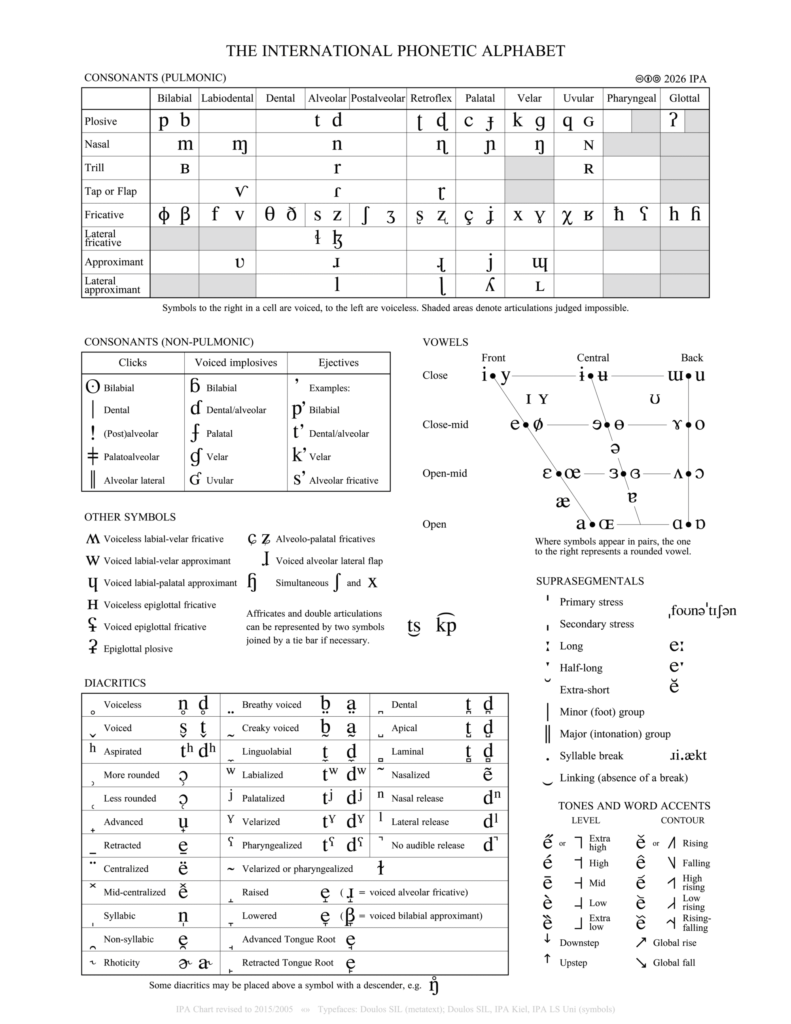
Oh, sorry for the jumpscare!
You don’t have to learn all of these letters and symbols to learn and use the IPA. In fact, it would be pointless. Remember, the IPA covers all the linguistically relevant sounds humans can make with their mouths across languages. Unless you’re planning to learn every language in the world—and learn them all at the same time—there’s no reason to learn all of those letters and symbols. Just learn the ones that represent the sounds of the language you’re studying.
Also, don’t get discouraged about having to learn the IPA for each different language, for many sounds that exist in one language also exist in another.
When you learn your next language, you’ll see many of the IPA letters you already know from your previous language.
So, if you wanna learn one more language, you’ll only need to learn a few more letters and symbols, not a whole new set of letters and symbols.
As an example of this, I can mention the example I gave in the beginning of this post: the Russian небо /ˈnʲebə/ and the English “balloon” /bəˈlun/. If you already know the IPA for English, then you already know how /bə/ sounds like in the IPA transcription of the Russian word небо /ˈnʲebə/. The only new things you’ll have to learn are that tiny “j” (that soften the previous consonant, which is called palatalization) and maybe the /e/, which is the same as the first part of the diphthong /eɪ/ (as in late) you already know.
In sum, (1) you don’t have to learn all those letters and (2) many sounds that exist in one language also exist in others, making everything easier.
Now, do you have to learn the IPA to learn a language? Is it “mandatory”?
Of course not.
The IPA was invented only in the eighteen hundreds, and before that people could learn languages without it—and still can.
Also, the study of phonology is not bound to IPA. You can learn phonology without the IPA, just as an iliterate person could learn their native language sounds without any alphabet. Well, all of us effectively learned our native language sounds without any alphabet first.
But the thing is, all this is easier and much faster to do through the IPA.
Why not learn the sound and also the letter right away? They’re not difficult to learn.
My point is, learning the IPA is an incredibly useful tool to have in your inventory. It does come with a learning curve, yes, but the effort will pay off in the long run. Your pronunciation will improve significantly, and you’ll be able to figure out how words are pronounced more accurately. Sounds you might not have picked up on just by listening will become apparent when you read an IPA transcription.
- “Palatoalveolar click.ogg” by Peter Isotalo, Wikimedia Commons, https://en.wikipedia.org/wiki/File:Palatoalveolar_click.ogg, licensed under CC BY-SA 3.0 (https://creativecommons.org/licenses/by-sa/3.0/). Used as-is. ↩︎
- “Postalveolar click.ogg” by Peter Isotalo, Wikimedia Commons, https://en.wikipedia.org/wiki/File:Postalveolar_click.ogg, licensed under CC BY-SA 3.0 (https://creativecommons.org/licenses/by-sa/3.0/). Used as-is. ↩︎
- “Bilabial click.ogg” by Peter Isotalo, Wikimedia Commons, https://en.wikipedia.org/wiki/File:Bilabial_click.ogg, licensed under CC BY-SA 3.0 (https://creativecommons.org/licenses/by-sa/3.0/). Used as-is. ↩︎
- Close central unrounded vowel.ogg” by Denelson83, Wikimedia Commons, https://en.wikipedia.org/wiki/File:Close_central_unrounded_vowel.ogg, licensed under CC BY-SA 3.0 (https://creativecommons.org/licenses/by-sa/3.0/). Used as-is. ↩︎
- Bilabial trill.ogg” by Peter Isotalo, Wikimedia Commons, https://en.wikipedia.org/wiki/File:Bilabial_trill.ogg, licensed under CC BY-SA 3.0 (https://creativecommons.org/licenses/by-sa/3.0/). Used as-is. ↩︎
- Voiceless dorso-palatal velar fricative.ogg” by Peter Isotalo, Wikimedia Commons, https://en.wikipedia.org/wiki/File:Voiceless_dorso-palatal_velar_fricative.ogg, licensed under CC BY-SA 3.0 (https://creativecommons.org/licenses/by-sa/3.0/). Used as-is. ↩︎
- International Phonetic Alphabet in IPA Kiel, www.internationalphoneticassociation.org/IPAcharts/common_files/pdfs/pdfs_IPA_charts_E/IPA_Kiel.pdf, available under a Creative Commons Attribution-Sharealike 4.0 International Deed. Copyright © 2026 International Phonetic Association. Date of access: 12 October 2026. ↩︎